
'Ideally, one should not time SIPs.' 'If people churn their SIP portfolios, then they are equating the concept of SIPs to lump sums.'

rediffGURU Dev Ashish answers your personal finance and mutual fund queries.

'More investors now view the stock market as a valuable opportunity, though many still seek quick gains, leading to a rise in futures and options trading.'

An interesting imaginary conversation between Kirtan A Shah and an investor about how investing in mutual funds is better than investing directly in stocks.
India's stock markets corrected recently but foreign money is likely to chase China rather than India in the short-to-medium term, said Chris Wood, global head of equity strategy at Jefferies, on Thursday. Wood told the Business Standard Manthan Summit in New Delhi he is bullish about Indian equities from a long-term perspective, but for the short term he is cautious given the quantum of foreign investor (FII) outflows and valuation woes.

If MSGF had shared the complete portfolio with its investors more frequently, the red flag on its misconceived investments might have been raised earlier.

Retail investors seem to have dipped into their mutual fund savings to meet pre-festival spending. According to data released by the Association of Mutual Funds in India (Amfi), investors pulled out Rs 6,578 crore from their systematic investment plan (SIP) accounts in September, the highest in the last 11 months. The redemptions were on the higher side during the previous festive season as well.

Anil Rego, CEO, Right Horizons, answers your personal income tax queries.

India's mutual funds are seeing a surge in stock investments from the hinterland as growing ranks of provincial retail investors help drive a two-year long rally.

Financial assets make a comeback as returns on physical assets falter.
The best advisers pick these no-load funds and ETFs to keep your portfolio on track this year.

Do you have financial planning queries? Ask rediffGURU Anil Rego.

PFRDA has issued these clarifications in response to queries received from pension fund managers seeking clarity on certain clauses of the investment management agreement for private sector.

After declining for three consecutive quarters, the value of FPI investment in Indian equities rose 8 per cent quarter-on-quarter to $566 billion in the July-September period, according to a Morningstar report on Wednesday. A fast-changing global macroeconomic landscape, sentiments and opportunities that the Indian equity markets have to offer impacted the direction of flows by Foreign Portfolio Investors (FPIs). Through the quarter, the value of the FPI holdings in domestic equities surged by 8 per cent to $566 billion from $523 billion recorded in the previous quarter.

Excess earnings of unlisted companies over and above their interest costs are at a record level. The interest-coverage ratio of 2.94 is the highest going back to 1990-91, according to numbers from the Centre for Monitoring Indian Economy (CMIE). The ratio measures earnings relative to every rupee to be paid as interest on outstanding debt.

In the past few years, MFs have emerged as significant institutional buyers, often offsetting the selling by FPIs.

Ask rediffGURU and PF expert Milind Vadjikar your insurance, stocks, mutual fund and personal finance-related questions.

'Market corrections are a natural part of investing, so it's essential to remain focused on long-term financial goals.'

While Angel One and Unifi Capital have obtained the final licence, Jio BlackRock, Capitalmind, Choice International and Cosmea Financial Holdings have received in-principle approvals.

Most large fund houses, such as HDFC MF, ICICI Prudential AMC, Reliance MF, Reliance MF, Birla SunLife MF and SBI MF, have the backing of large banks or financial institutions, giving them reach and understanding, they say.

Multi-asset allocation funds emerged as the most popular option for MFs as they provided the needed flexibility.

'Sector funds like IT funds should be included only in the satellite portfolio.' 'Limit your exposure to IT sector funds to around 5-10 per cent of your equity portfolio.'
The country's biggest mutual fund, UTI Mutual Fund, on Monday announced the launch of its new scheme 'UTI-Dividend Yield Fund', which will invest in 60-70 high dividend yield stocks.
History has shown that cyclical stocks (capital goods, metals, banking, infrastructure, etc) are some of the best performing stocks in an up-cycle.

Omkeshwar Singh, head, Rank MF, a mutual fund investment platform, answers your queries
Conservative industry estimates place the cash component of mutual fund houses at Rs 25,000 crore (Rs 250 billion). Fund houses had up to 15 per cent in cash, as per the April 30 figures. The cash component exceeded 15 per cent in as many as 30 diversified equity growth funds.

AI isn't a magic wand. It works best when combined with good systems, informed investors, and skilled advisors, says Amit Suri.

'Investors should allocate about 5% to 10% to such funds.'
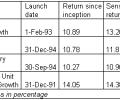
Are diversified equity funds better than index funds? How do they compare over a ten year period? Who wins?

While looking to give a boost to the mutual fund sector with some contribution from about Rs 5.5 lakh crore (Rs 5.5 trillion) corpus being managed by Employee Provident Fund Organisation, Sebi feels that age restrictions would safeguard investors from 'unnecessary risks' during years closer to their retirement.
Ruling out mergers and acquisitions in the immediate future, JM Mutual Fund, with assets nearing Rs 4,500 crore, on Thursday said it was planning to launch three more schemes by the first quarter of 2004-05.
Be on your guard while dealing with MF advisors, says personal finance expert Rahul Goel.

In the last few months, the 10-year G-Sec has been gyrating sharply and has crossed the 9-per cent-yield mark four times.

rediffGURU and financial planning expert Colonel Sanjeev Govila (retd) answers your personal finance-related questions.

Mutual funds are a popular investment tool for investors because it offers a convenient and cost-effective way to invest in the financial markets.

At the end of the day, this isn't about choosing between EMIs and SIPs. It's about choosing your path to financial freedom.

Younger people, who usually have a longer investment horizon which allows them to handle the interim volatility, may go for them.
